
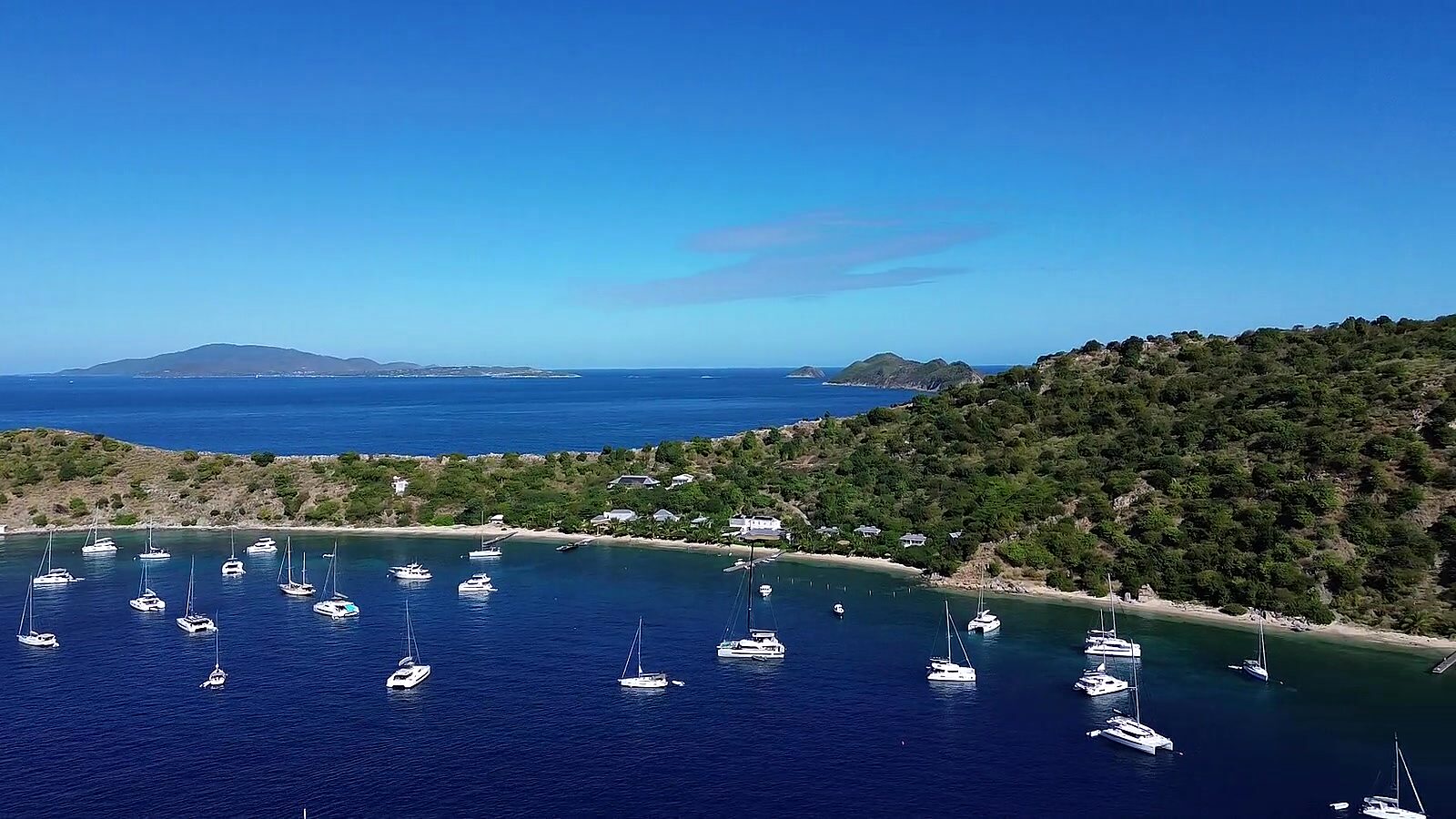
Everything the brochure leaves out: whether you qualify, what the week really costs, how the three kinds of mooring ball work, clearing customs, and the rules that catch visiting skippers out. Figures checked in September 2026.
Do I qualify to skipper?
The BVI does not ask for a licence. The charter company asks for a sailing resume, and what it wants to see is time in command of something like the boat you are booking. The Moorings rates the BVI as its easiest sailing area and looks for about nine days and a hundred miles as skipper on a similar yacht. Dream Yacht and Navigare say the same in fewer words: no formal qualification, resume required. ASA, RYA, ICC and US Sailing tickets are welcome but optional.
Be honest on the resume. If the base is not convinced on the day, it can put a captain aboard at your expense. Better to book a checkout captain yourself for the first afternoon, at about $200 to $250, learn the boat properly, and start the week relaxed. If you have only sailed monohulls and have booked a 45 foot catamaran, do this.
What the week really costs
The charter fee is the biggest number, but it is not the last one. These are the extras for a typical week, in US dollars.
| Extra | Expect | Notes |
|---|---|---|
| Cruising permit | $6 per person per day | For BVI-based charter boats, all year. Boats based outside the BVI pay more. It is usually on your charter invoice. |
| National Parks permit | $25 to $55 per week | By crew size: up to 4, 6, 8 or 10 people. Some companies include it. |
| Environmental levy | $10 per person | Paid on arrival in the BVI, by air or ferry. |
| Departure tax | $20 per person | Paid when you leave. |
| Moorings | $40 to $55 per night | Six nights on balls is $240 to $330. |
| Fuel | $200 to $600 per week | Diesel is about $8 a gallon and dinghy gasoline about $7 in late 2026, and rising. Catamarans with generators and air conditioning sit at the top of the range. |
| Deposit or damage waiver | $600 to $900 waiver, or a deposit of about $3,000 | A waiver costs more up front but caps what you can lose. |
| Food and drink | $50 to $75 per person per day | If you provision fully. Less if you eat ashore less than you think you will. |
| Checkout captain | $200 to $250 | Optional, first day only. Money well spent if you have not handled a big catamaran before. |
Mooring balls: there are three kinds
First come, first served
$40 a night
White balls with an orange BoatyBall sticker, and other private moorings in most bays. Tie up, then pay in the BoatyBall app by choosing the bay and the ball number. In high season the popular fields are full by early to mid afternoon, so arrive early or have a plan B.
BoatyBall reservable
$55 a night
Bright orange, pear-shaped and numbered. Booking opens at 7:00 am local time for that night only and the best bays go in minutes, so be on the app at 6:59. Check-in is from noon and you must be off by noon next day. Found at Cooper Island, Cane Garden Bay, Great Harbour and Little Harbour on Jost, Diamond Cay, Marina Cay, Soper’s Hole, Leverick Bay, Saba Rock, Oil Nut Bay and Anegada.
National Parks day moorings
Permit, no nightly fee
At the snorkel and dive sites: the Indians, the Caves, the Rhone, the Dogs, Monkey Point, Sandy Cay and the Baths. Day use only, never overnight, keep to the posted time limit, and you need the weekly parks permit from your charter base. Buoy colours mean different uses, so ask at your chart briefing which ones are yours.
Always check a mooring before you trust it: look at the pennant for chafe, back down gently, and dive on it if you are staying in a blow. See every anchorage and mooring field for which bays have which kind.
The skills that matter, in pictures
You do not need to be a racer. You need to pick up a mooring without drama, set an anchor you trust, and read the colour of the water. Here is each one in pictures.
How to pick up a mooring ball on a catamaran
1Come up into the wind, slowly
Approach from downwind at walking pace with the ball dead ahead between the bows. Put your tallest crew on the bow with the boat hook and agree hand signals first: the helm cannot see the ball for the last few metres.
2Two lines through the eye
Lift the pennant with the boat hook. Run one dock line from the port bow cleat through the eye and back to the same cleat, then a second line the same way from the starboard bow. Never drop the pennant eye straight over a cleat, and never use one line from side to side: it saws through.
3Even them up, then test it
Adjust until both lines are the same length and the ball sits a couple of metres ahead between the bows. Look at the pennant for chafe, back down gently to load it, and pay in the app. If it looks tired, move.
How to anchor in sand
1Find sand, not coral or grass
Pale turquoise is sand. Dark patches are coral, rock or seagrass, where anchoring is either illegal or will not hold. Motor a slow circle to check you can swing all the way round without touching anything or anyone.
2Drop, drift back, let out scope
Stop head to wind over the sand, lower the anchor to the bottom, then let the boat drift back as you pay out chain. Five times the depth is the minimum, measured from the bow roller and not the waterline. Seven times if it is going to blow.
3Back down, then go and look
With the scope out, reverse gently and build to about half throttle. Watch two fixed objects ashore in line: if they stay in line, you are holding. Then snorkel over the anchor. It should be buried in sand with the chain lying flat.
How to read the water
With the sun high and behind you, and polarised sunglasses on, the colour of the water is a depth sounder you can see ahead of the boat. Between about 9 am and 4 pm it works. With the sun low or in your eyes it does not.
- Deep blueDeep water. Go anywhere.
- Blue-greenThirty feet or more over sand. Safe.
- Bright turquoiseTen to twenty five feet over sand. Where you want to anchor.
- Pale green to whiteShallow sand, a few feet. Slow down, watch the depth.
- Brown or yellow-brownCoral or rock close to the surface. Stay away.
- Dark patches in turquoiseSeagrass or coral heads. Do not anchor on them.
How to time your day
The BVI rewards early starts. The whole day hangs off two facts: moorings go early, and you cannot see reefs late.
- 7:00BoatyBall opensBook tonight's reservable mooring.
- 8:30Under wayBeat the day boats to the snorkel spot.
- 12:00Lunch stopParks mooring or a sand patch. Day use only.
- 2:30Tied up for the nightFirst-come fields fill from now in season.
- 5:00Latest sensible arrivalReefs vanish when the sun is low ahead of you.
The first day
Where you start. The Moorings and Sunsail are at Wickhams Cay II in Road Town. Nanny Cay, Hodges Creek at the east end of Tortola and Scrub Island are the other main bases. Most people fly to St Thomas and take the ferry to Road Town or West End, about $60 each way, with the last boat around 4:30 to 5 pm. Fill in the BVI online entry form before you travel, and have $10 each ready for the environmental levy.
Sleep aboard. Most companies let you board the evening before, from about 5 or 6 pm, for an extra fee. Take it. You unpack, stow the food and sleep off the travel, and you are first in line for the briefing in the morning.
Briefings. Expect a chart briefing, at set times such as 9:30, noon or 4 pm, and then a boat briefing of an hour or more. Film the boat briefing on your phone. Ask three things before they leave: where the red-lined areas are, how to reach the base after hours, and how the holding tanks work.
Provisioning. Order ahead and have it delivered to the dock, then buy less than you think: you will eat ashore more than you plan to. The full run-down is in provisioning below.
First night. Keep it to an hour’s sail. The Bight at Norman Island or Great Harbour on Peter Island from Road Town and Nanny Cay; Marina Cay or Trellis Bay from the east end.
Provisioning: where to stock the boat
Tortola is where you do the big shop. Everything after that is a top-up: bread, ice, fruit, the thing you forgot. Prices run well above the US mainland everywhere, and they climb the further you get from Road Town. Details checked in September 2026. Hours and owners change, so ring ahead for anything you are counting on.
Where the shops are
Every grocery, bakery and drinks shop mentioned below, on one map. Tap a pin for the basics, then jump to our notes.
Not for navigational purposes. Positions are approximate. Opening hours change, so ring ahead.
- Supermarket: do the big shop
- Small shop: top-ups
- Bakery or drinks
Delivered to your dock on Tortola
RiteWay Provisioning
The biggest grocer in the BVI, with a dedicated yacht provisioning desk at Pasea in Road Town. Order online, by 2 pm for the next business day or up to 30 days ahead, and they deliver to the charter docks on Tortola, Nanny Cay and Scrub Island. Website prices match the shelf price. Phone 284 347 1188.
Bobby’s Marketplace
Road Town, popular with charter crews for years. You fill in their order form and email it back. Free delivery anywhere on Tortola, and the shop is open from 7 am to midnight. Phone 284 494 2189.
Drinks: Tico and Caribbean Cellars
Beer, wine and spirits cost less from a drinks wholesaler than from a supermarket. Tico in Road Town takes orders online and delivers to the dock. Rum is cheap here. Wine and mixers are not.
Your charter company
Most bases sell their own provisioning packages and want about five days’ notice. It is the least effort and usually the most money. Split provisioning, where you skip some dinners, is the one to look at, because you will eat ashore.
The closest grocery to your base
| If you start from | Closest shops | Notes |
|---|---|---|
| Road Town: Wickhams Cay II, Village Cay, Road Reef | RiteWay Pasea, RiteWay Road Reef, Bobby’s, OneMart at Port Purcell | RiteWay Pasea is the flagship, open 6:30 am to 10 pm every day. All are a short taxi ride, and Road Reef is a walk from the Road Reef docks. |
| Nanny Cay | RiteWay Nanny Cay, inside the marina | Open 7 am to 7 pm daily. Walk your bags to the boat in a dock cart. |
| Soper’s Hole, West End | RiteWay Soper’s Hole, on the wharf | Open 7 am to 7 pm daily. Also the last proper shop before Jost Van Dyke. |
| Hodges Creek and Fat Hogs Bay, East End | RiteWay East End, Fine Foods at Parham Town | Both open daily into the evening. |
| Scrub Island and Trellis Bay | Delivery from Road Town, Trellis Bay Market Bar and Grill | Order the big shop ahead. Trellis Bay Market is on the beach by the dinghy dock, a market with a bar and grill attached, open into the evening and handy for top-ups and a meal while you wait for crew to land. |
Top-ups along the way
Spanish Town, Virgin Gorda
The best mid-week shop in the islands. RiteWay Virgin Gorda and Buck’s Food Market are both a short walk or taxi from the Yacht Harbour. Do it on the same stop as the Baths.
Leverick Bay, North Sound
Chef’s Pantry Supermarket and Deli is inside the Leverick Bay marina, a few steps from the dock: vegetables, meat and seafood, deli, dairy and cheese, wine, liquor and beer, spices and a small pharmacy shelf. Open daily, to 7 pm when we checked. Fuel, water and ice are on the same dock, and Buck’s has a smaller shop across the water at Gun Creek. This is the sensible place to restock before Anegada.
Bitter End, North Sound
The Market at Bitter End is open 7:30 am to 6 pm: fresh bread, key lime pie, produce, fish, ice, water, wine and spirits. Good quality, resort prices.
Anegada
Lil Bits Cash and Carry, in The Settlement a short taxi ride from the Setting Point anchorage, is the island’s grocery. It closes around 5:30 pm. There is also a bakery at Neptune’s Treasure on the waterfront. Fine for bread, ice and basics. Do not arrive expecting to provision.
Jost Van Dyke
Three stops in Great Harbour, all top-ups. Rudy’s Marketplace, a short walk up the road from the beach in Belle Vue, is the island’s grocery store and stays open to about 7 pm. Christine’s Bakery, just up from the town dock, does fresh bread, pastries and cookies until about 5 pm. North Latitude Marina, on the west side of the harbour, has a small shop with basic provisions and closes around 5 pm. Do the real shop at Soper’s Hole before you cross.
Cane Garden Bay, Tortola
Bobby’s and Rhymer’s both have small supermarkets just off the beach.
Cooper, Norman and Peter
No grocery shops. Ice and a few basics at the beach clubs at best. Arrive with what you need.
Delivered to the boat at anchor
Small boats do work some of the busy anchorages selling ice, bread and pastries and taking rubbish away, most often in The Bight at Norman Island and at Cooper Island. They run on VHF and cash, keep no timetable and come and go from one season to the next. Treat them as a bonus, not a plan. If you are stuck, the provisioning desks on Tortola will sometimes send an order out by ferry or water taxi to Virgin Gorda or Jost Van Dyke for a fee, so it is worth a phone call.
Four rules that save money and space. Plan dinners ashore first, then shop for what is left. Buy drinking water in gallon jugs, not small bottles. Freeze meat flat before it goes in the boat fridge, because charter fridges are small and slow. Bring your own spices, coffee and zip bags from home.
Customs, and going to the USVI
If you stay inside the BVI for the week, the charter company has handled the paperwork and you never see a customs officer after the ferry dock.
Going to St John is a different matter, and three things all have to be true. Your charter company must allow it and know in advance. The boat must clear out of the BVI and back in again, at Great Harbour on Jost Van Dyke, West End, Road Town or Spanish Town, during office hours, which are roughly 8:30 am to 4:30 pm. And everyone aboard must report to US Customs and Border Protection on arrival, normally with the CBP ROAM app, clearing at Cruz Bay.
The trap is for non-US citizens. Anyone who needs a visa, and visa-waiver travellers who have not already entered the US on a commercial carrier, cannot make their entry on a charter boat, because a charter boat is not a recognised carrier. Penalties start at $5,000 and can include the boat. If anyone in your crew is not a US citizen or resident, confirm with CBP before you plan it.
Rules that catch visitors out
No night sailing
Be secured about an hour before sunset. It is in nearly every contract, and it is how you avoid the reefs.
Red-lined areas
Each company marks places its boats may not go. Common ones are the cut between Great Camanoe and Beef Island, the western entrance to North Sound, Eustatia Sound and anywhere at Anegada outside the marked channel and anchorage. Ask at the chart briefing, because insurance stops at the red line.
Fishing needs a permit
Anyone 18 or over needs a recreational fishing permit, about $45 for up to a month, usually arranged through your charter company. No spearfishing, nothing taken while on scuba, no fishing in the marine parks, and visitors may not take lobster.
Parks moorings are day use only
No overnighting, keep to posted time limits, and no anchoring within 100 yards of a parks mooring. The fines on the books run to $10,000.
Never anchor on coral
Sand only. If you cannot see sand, do not drop. In several bays the bottom is seagrass or reef and the answer is a mooring.
Cover up ashore
Swimwear is for the beach and the boat. Put a shirt on in town, in shops and in customs offices.
Drones have rules
Stay under 400 feet, keep 50 metres from people, boats and buildings, stay well clear of the airport at Beef Island, and get permission for anything commercial.
Drugs
Possession is a criminal offence with fines or jail, including cannabis, whatever the law says at home.
If something goes wrong
Then call your charter base. They know where you are, they have a chase boat, and most problems on a charter boat are theirs to fix. Save the after-hours number in your phone before you leave the dock, and check the marine forecast every morning.
Money, power and phones
Money
US dollars. Cards are fine at marinas and restaurants, but carry cash for beach bars, taxis and tips. Tip 10 to 15 percent.
Power
110 volts with US plugs. Shore power at the dock, generator or inverter at anchor. Bring a 12 volt USB charger.
Time
Atlantic Standard Time, UTC minus 4, all year. No daylight saving, so the BVI matches US Eastern time in summer and is an hour ahead in winter.
Phones
Coverage is good in most anchorages. Check roaming rates before you go, and watch for your phone jumping onto a US tower near St John. Boat WiFi is an extra.
Bareboat charter questions, answered straight
Do you need a licence to charter a bareboat in the BVI?
No formal licence is required. Charter companies ask for a sailing resume instead, and want to see that you have skippered a similar size and type of boat before: The Moorings, for example, looks for roughly nine days and a hundred miles as skipper. ASA, RYA, ICC and US Sailing certificates help but are optional. If your resume is thin, the base can put a checkout captain aboard for the first day for about $200 to $250.
How much do mooring balls cost in the BVI?
Expect $40 a night for a first-come mooring and $55 a night for a reservable orange BoatyBall mooring, paid through the BoatyBall app. Reservable balls are released at 7 am local time for that same night only, and the popular bays sell out within minutes in high season. National Parks Trust day moorings at the snorkel and dive sites are covered by your weekly parks permit, not a nightly fee.
What extra costs are there on a BVI bareboat charter?
Beyond the boat: a cruising permit of $6 per person per day, a National Parks permit of $25 to $55 for the week depending on crew size, a $10 per person environmental levy on arrival and a $20 departure tax, mooring fees of $40 to $55 a night, fuel of roughly $200 to $600 for the week, the security deposit or damage waiver, and food at around $50 to $75 per person per day if you provision fully.
Can I sail a BVI charter boat to St John in the USVI?
Sometimes. Your charter company has to allow it and be told in advance, the boat must clear out of the BVI and back in, and everyone aboard must report to US Customs and Border Protection, normally through the CBP ROAM app, on arrival. Anyone who needs a visa, and visa-waiver (ESTA) travellers who have not already entered the US by a commercial carrier, cannot make their entry on a charter boat. Penalties for getting it wrong start at $5,000.
Can you sail at night on a BVI bareboat charter?
No. Almost every charter contract prohibits night sailing and requires you to be on a mooring, anchored or docked about an hour before sunset. Reefs are unlit and close to invisible in low light, so plan every day to arrive by mid-afternoon.
Who do you call in an emergency on the water in the BVI?
Call Virgin Islands Search and Rescue (VISAR) on 767 from a local phone or +1 284 499 0911, or put out a call on VHF channel 16. For police, fire or ambulance dial 999 or 911. The main hospital with 24-hour emergency care is Peebles Hospital in Road Town, Tortola. Call your charter base as well: they know where you are and have a chase boat.
Where do you buy groceries for a BVI bareboat charter?
On Tortola, before you leave the base. RiteWay and Bobby’s in Road Town both take orders ahead and deliver to the charter docks, and there are RiteWay shops inside Nanny Cay marina and on the wharf at Soper’s Hole. After that you top up at Spanish Town, Leverick Bay or Bitter End on Virgin Gorda.
Can you get provisions delivered to a charter boat in the BVI?
Yes, to the dock on Tortola. RiteWay Provisioning delivers orders placed online by 2 pm for the next business day, and Bobby’s delivers free anywhere on Tortola. Delivery to a boat at anchor is not something to rely on: a few small boats sell ice and bread in busy anchorages, but they keep no schedule.
Where can you reprovision in the middle of a BVI charter?
Spanish Town on Virgin Gorda has the best shops outside Tortola, with RiteWay and Buck’s near the Yacht Harbour. In North Sound there is Chef’s Pantry Supermarket at Leverick Bay and The Market at Bitter End. Soper’s Hole has a RiteWay on the wharf. Anegada has Lil Bits Cash and Carry in The Settlement, and Jost Van Dyke has Rudy’s Marketplace, Christine’s Bakery and the small shop at North Latitude Marina, all in Great Harbour. Both are top-up stops only.
Fees and rules change, and the sources do not always agree, which we have flagged where it matters. Prices here were checked against government notices, BoatyBall and the charter companies’ own pages in September 2026. Your charter contract and your base briefing always win.